Building AI Agents for AI Search Visibility
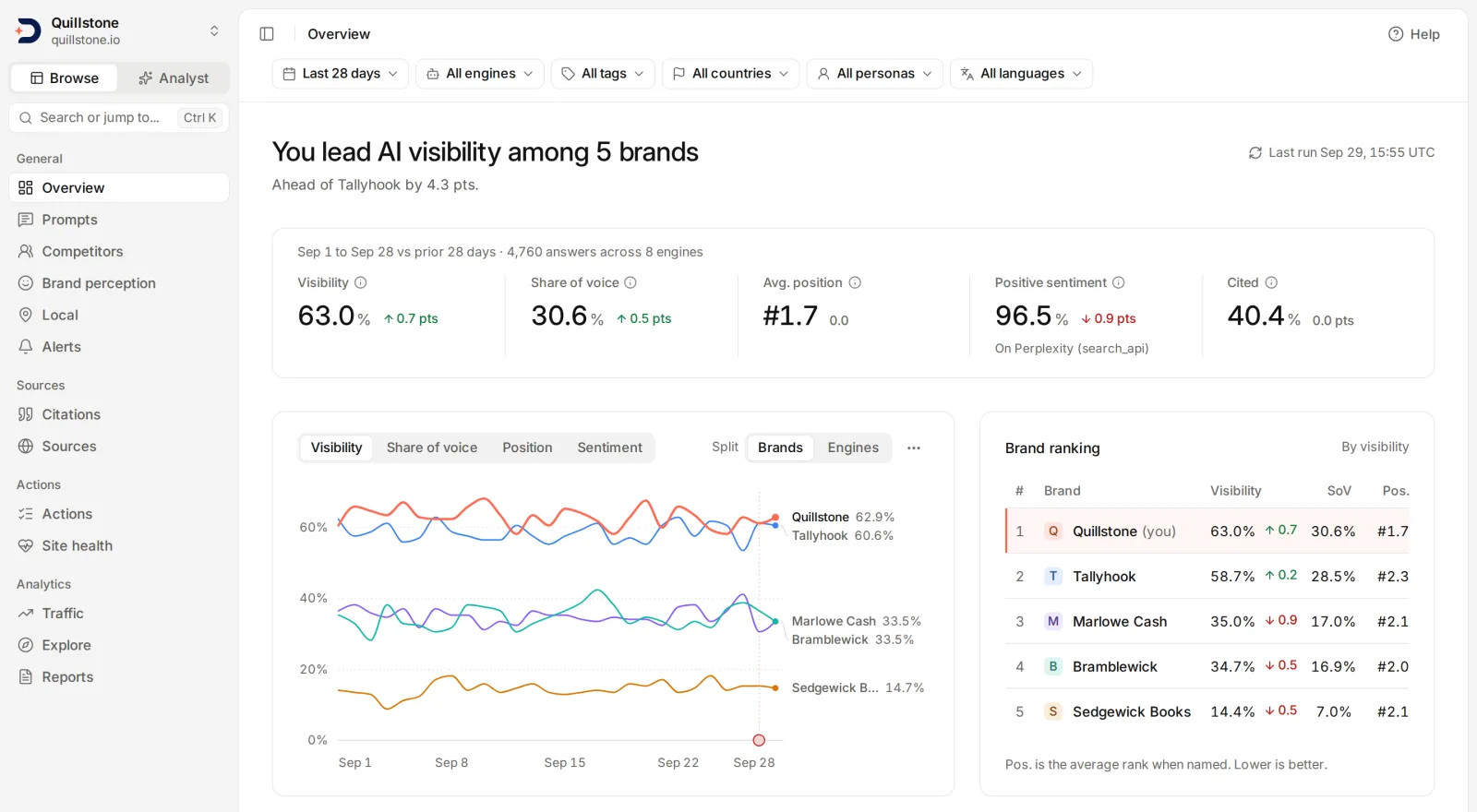
DiscoveredBy shows brands how they appear in ChatGPT, Gemini, Perplexity, Claude, Grok, and Google's AI answers, then uses twelve AI agents to explain why and what to fix. We built it end to end on FastAPI and SvelteKit, and we run it.
Category
AI Agents / FastAPI / SvelteKit
Project Type
Our own product: we build, run, and operate it
Industry
Generative engine optimization (GEO) and AI search visibility
The Problem
Buyers now ask AI engines which product to choose. Traditional SEO tools do not show whether those answers mention a brand, how they frame it, which pages they cite, or why a competitor gets recommended instead.
Marketing teams, PR teams, and agencies needed that picture across engines, countries, cities, and buyer personas, plus specific changes that would improve it, not another dashboard of raw numbers.
What We Built
- visibility, position, and share of voice for every tracked prompt, by country, city, persona, or language
- how each AI answer frames the brand, with the quoted line behind every verdict
- which pages AI engines cite, and where competitors win citations you lose
- ranked fixes, copy-ready page edits, article drafts sent to WordPress, and llms.txt audits
- Search Console and GA4 data joined to AI visibility, down to revenue attribution
- which AI crawlers fetch your pages, from Cloudflare or server logs
- daily alerts, weekly reports, agency client reports, and a customer API and MCP server
Engines tracked: ChatGPT (app), Gemini (app and API), Perplexity, Claude, Grok, Google AI Overviews, Google AI Mode.
From a Buyer's Question to a Fix
One tracked prompt, followed through the platform: the engines answer, the agents read what they said, and the team gets a change to make.
Step 1
A buyer asks an AI engine
"What is the best bookkeeping app for freelancers?"
Step 2
Eight engines answer, every day
- ChatGPT
- Gemini
- Gemini API
- Perplexity
- Claude
- Grok
- AI Overviews
- AI Mode
Step 3
Agents read every answer
-
Sentiment & Framing
Named as a top pick, positive
-
Visibility Watchdog
Named in 5 of 8 engines
-
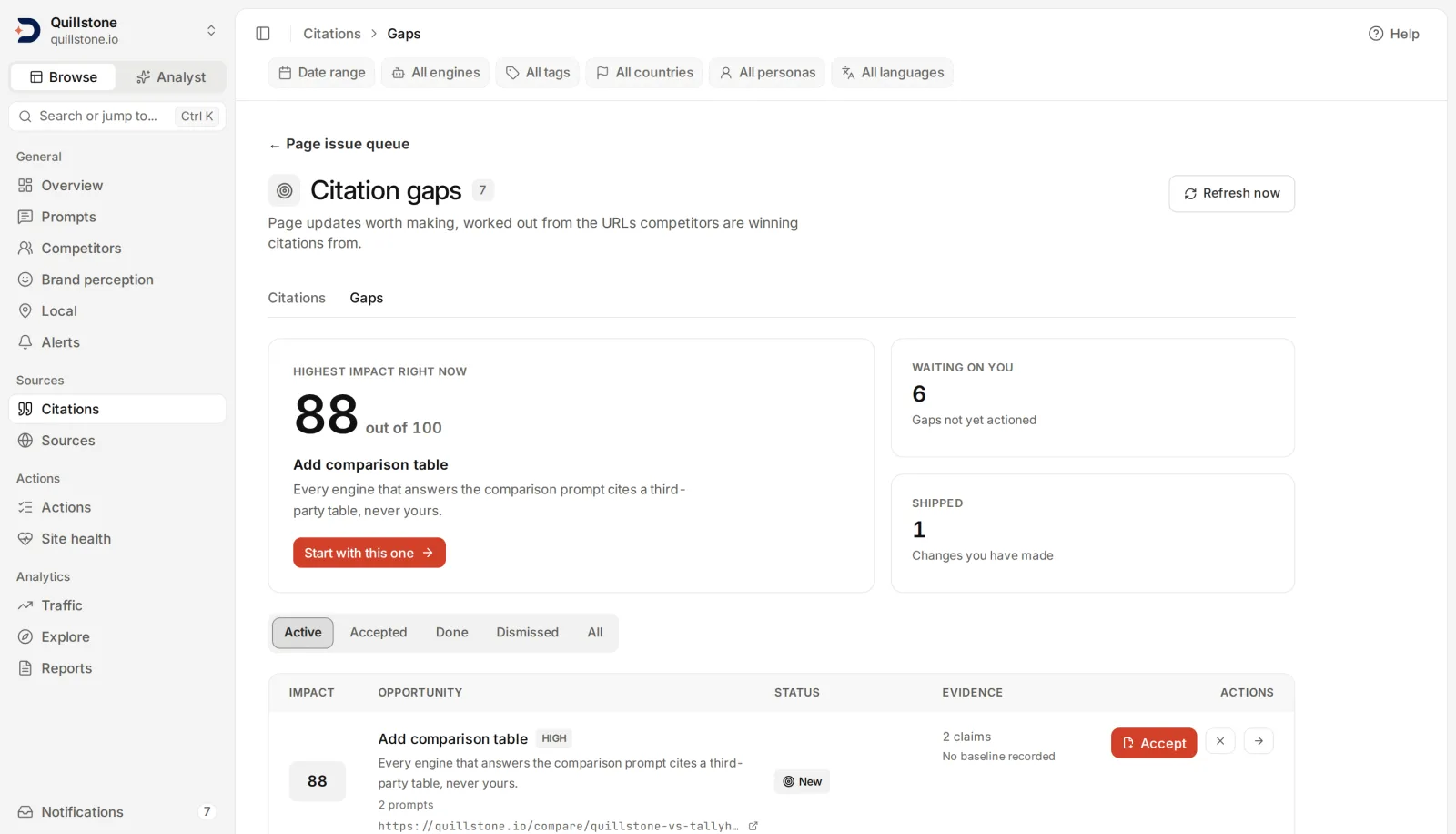
Citation Gap Finder
Competitor table cited, not yours
Step 4
Your team gets a ranked fix
Add a comparison table
Engines answering the comparison prompt cite a third-party table, never yours.
Twelve Agents in Production
Each agent does one job and hands its findings to the others. Together they move from tracking, to diagnosis, to a fix a team can ship.
Business Profiler
Reads the site on connect and builds the business profile every other agent works from.
Prompt Discovery
Finds the high-intent prompts a brand should be tracking.
Sentiment & Framing
Classifies how each answer positions the brand and quotes the line that shows why.
Visibility Watchdog
Runs daily, flags material moves, and names the prompts and engine behind them.
Citation Gap Finder
Reads the competitor page AI chose and ranks the fixes that could close the gap.
Article Topic Planner
Plans the articles most likely to earn citations.
Article Writer
Decides which page should win a prompt and drafts it, grounded in scraped evidence.
On-Page Optimization
Turns a citation gap into a copy-ready edit for an existing page.
llms.txt Advisor
Audits llms.txt against the spec and writes a compliant version.
Search Console Reconciliation
Finds queries that win in Google but vanish from AI answers.
Revenue Attribution
Connects AI citations to traffic and revenue in GA4.
Growth Advisor
Writes a weekly or on-demand growth briefing from everything the other agents found.
How It Is Built
A plain, observable stack: one async API, agents as queued workers, and every model call logged with its cost.
Async FastAPI backend
An async FastAPI backend on PostgreSQL, with versioned schema migrations.
Agents as queued workers
Each agent runs as a background job, so slow AI calls never hold up the app, and daily scans run on a schedule.
One gateway for every model call
Every agent call goes through one gateway that enforces a strict output schema and records the call and its cost.
One adapter per engine
Each AI engine sits behind the same small interface, so engines can be added or changed without touching the agents.
Raw data kept, scores derived
Answers and citations are stored first and scores are derived from them, so results can be recalculated without paying for the AI call again.
Two SvelteKit apps
A Svelte 5 marketing site and a separate SvelteKit product dashboard, both on Tailwind CSS, talking to the FastAPI API.
Integrations and Developer Access
The data has to meet teams where they already work: their Google accounts, their CDN logs, their CMS, and their own AI assistants.
Google Search Console and GA4
Connect a Google account and matching properties map to the right project on their own. Search demand and AI-referred sessions sit next to AI visibility.
AI crawler analytics
Cloudflare Worker or Logpush, NDJSON from log shippers, or Combined Log Format uploads. Only known AI bots are kept, and client IP addresses are never stored.
Customer API
A read-only JSON API with project-scoped keys that can expire or be revoked.
MCP connector
A read-only MCP server, so customers can ask their own AI assistant about their tracked answers.
Also: WordPress draft publishing, Google sign-in, CSV and Excel prompt imports, and CSV and JSON exports.
Why This Was Hard
Agents that call paid AI engines every day, on untrusted web content, for many customers, have to be cheap, safe, and repeatable before they are clever.
AI answers vary from run to run and engine to engine, so a single check is not a measurement: visibility had to be tracked over repeated daily runs
scraped pages and AI answers are untrusted input, so agents had to treat them as data, not instructions, and every output is validated before it is used
querying many paid AI engines for every customer needed cost control built in from the start, not added after the first bill
daily scans had to be safe to retry, and one failing engine could never stop the others
each engine returns answers and citations in its own format, and every one had to land in the same comparable shape
raw tracking was not enough: users needed ranked, specific fixes they could ship, then a way to see what changed afterwards
How It Shipped
Small releases, every week, in public. Each month below comes from the dated product changelog.
Read the changelog-
June 2026
Google data inside the app
Search Console queries and pages, and Google Analytics sessions, shown next to AI visibility.
-
July 2026
Agents that recommend, not just report
Growth Advisor, llms.txt Advisor, citation gaps, page optimizations, and dated weekly reports.
-
August 2026
Showing the work
Fan-out queries showing what each engine actually searched for, and CSV exports.
Outcome
- live at discoveredby.ai as a GEO and AI search visibility platform for marketing, content, PR, and agency teams
- tracks brands across eight AI engines, from ChatGPT to Google AI Mode
- twelve production agents covering tracking, diagnosis, content, and reporting in one workflow
What Carries Over to Your Project
You may not need AI search tracking. If you are adding AI agents to your own product, these are the parts of DiscoveredBy we bring with us.
Agents you can audit
Every model call recorded with its input, output, and cost, so you can answer "why did the AI say that?"
Outputs your code can trust
Strict schemas on every agent response, with a repair retry or a clear error state instead of free text leaking into your product.
AI spend that stays predictable
Per-call cost tracking and usage limits, designed in from the start rather than added after the first bill.
Failures that stay contained
Idempotent jobs and isolated providers, so one slow or failing model never takes the rest of the pipeline down.
An API and MCP for your customers
Scoped keys and a read-only MCP connector, so your users can bring your data into their own AI tools.
Tests that let you ship weekly
A large automated test suite is what makes weekly releases safe. We bring the same habit to client builds.
Relevant Services
DiscoveredBy is our clearest proof for AI agents that run in production on a FastAPI and SvelteKit stack.
AI Agent Development
Twelve agents in production, with schema-locked outputs, cost tracking, and safe retries.
Open pageFastAPI Development
An async FastAPI backend with queued workers, scheduled jobs, and a customer API and MCP server.
Open pageSvelteKit Development
A SvelteKit marketing site and a separate SvelteKit product dashboard on the same API.
Open pageQuestions About This Build
Did MicroPyramid build DiscoveredBy?
Yes. DiscoveredBy is our own product. Our team designed, built, and runs the FastAPI platform, the twelve agents, and both SvelteKit apps, and we ship to it every week.
Can you build a similar AI agent platform for our business?
Yes. The patterns on this page (audited model calls, schema-locked outputs, cost controls, queued agents, and a customer API) apply to any product where AI agents read data, make a judgement, and hand a result to a person or another system. We start with a discovery sprint and give a fixed estimate after it.
Which AI models do you work with?
DiscoveredBy works with OpenAI, Anthropic Claude, Google Gemini, Perplexity, and xAI Grok, each behind its own adapter. We pick models per task for client builds and keep them swappable, so you are not locked to one vendor.
Can you add AI agents to an existing product instead of starting fresh?
Yes. Most agents in DiscoveredBy are ordinary background jobs that read from the database and write structured results back. The same approach fits into an existing Django, FastAPI, or Node application without a rewrite.
Need AI Agents That Hold Up in Production?
We build agents with the same guardrails we run on DiscoveredBy: strict output schemas, cost tracking, safe retries, and a team that keeps them running.